Cricket is one of the oldest and most respected sports in the world. Over the centuries, the game has evolved in many ways, including changes in rules, playing conditions, and formats. One of the most interesting aspects of cricket history is the number of balls in an over.
Today, cricket fans across the world are familiar with the modern rule: one over contains six balls. However, this was not always the case. In fact, the number of balls in an over has changed multiple times throughout cricket’s history.
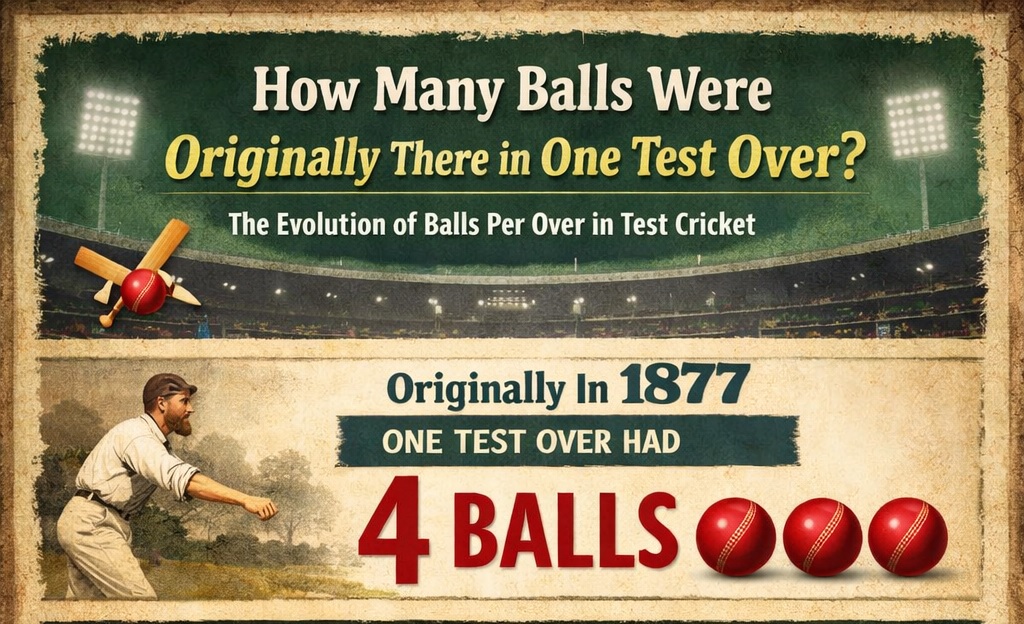
A common question that often appears in cricket trivia and even search trends is: How many balls were originally there in one Test over?
The answer is four balls. When Test cricket began in the 19th century, an over consisted of only four deliveries. Over time, different countries experimented with various over lengths such as five, six, and even eight balls before the International Cricket Council standardized the rule.
Table of Contents
What Is an Over in Cricket?
Before diving into the historical details, it is important to understand what an over means in cricket.
An over is a set of consecutive deliveries bowled by one bowler from one end of the pitch. Once the over is completed, another bowler bowls from the opposite end.
Key Rules of an Over
- The bowler delivers a fixed number of legal balls.
- After an over ends, the field changes ends.
- A different bowler must bowl the next over.
- Wide balls and no-balls do not count as legal deliveries.
Overs are fundamental to the structure of cricket matches. They control pacing, strategy, and gameplay in all formats including Test matches, One Day Internationals (ODIs), and Twenty20 cricket.
The Origin of Overs in Cricket
In early cricket during the 18th and early 19th centuries, the concept of overs was still evolving. Bowlers often delivered several balls in succession, but the exact number was not strictly standardized.
The term “over” originally meant that the bowler had completed a set of deliveries and it was “over” for that bowler before another took over.
When formal laws of cricket began to develop in England, the number of deliveries per over was officially defined.
How Many Balls Were Originally There in One Test Over?
When Test cricket began in 1877, the standard rule was:
One over consisted of four balls.
This rule was adopted from the early Laws of Cricket that governed the game in England during the 19th century.
Why Only Four Balls?
There were several reasons why early overs had fewer deliveries:
- Slower bowling styles
Early bowlers often used underarm or round-arm techniques. - Longer matches
Matches lasted multiple days, so there was less pressure to speed up play. - Player stamina considerations
Bowling multiple deliveries repeatedly was physically demanding. - Uncovered pitches
Pitches were rough and unpredictable, making bowling more difficult.
Because of these factors, four deliveries were considered sufficient for one over.
Early Test Cricket and Four-Ball Overs
The first official Test match took place in 1877 between England and Australia in Melbourne. During this match, bowlers delivered four balls per over, which was the standard at the time.
Many early Test matches followed this rule. However, as cricket grew internationally, different cricket boards began experimenting with different over lengths.
This led to a fascinating period where overs varied depending on the country hosting the match.
Timeline of Ball Changes in Test Overs
Throughout cricket history, the number of balls in an over has changed multiple times before settling on the modern standard.
Below is a simplified historical timeline.
| Year / Period | Balls Per Over | Country / Context | Key Notes |
|---|---|---|---|
| Pre-1889 | 4 balls | England and early Test cricket | Original rule used in early matches |
| 1889 | 5 balls | England | Experiment to speed up the game |
| 1890s | 6 balls | Gradually adopted | Became increasingly common |
| Early 1900s | 6 balls | England standard | Many countries followed |
| 1920s–1970s | 8 balls | Australia, New Zealand, South Africa | Unique national rule |
| 1979–1980 | 6 balls | Global standard | Officially standardized worldwide |
This timeline highlights how cricket evolved through experimentation before settling on a consistent rule.
The Era of Five-Ball Overs
In 1889, England introduced five-ball overs. This was one of the earliest attempts to modify the pace of the game.
Why England Tried Five Balls
The change was made for several reasons:
- To improve match flow
- To reduce long bowling spells
- To make scoring patterns more balanced
However, five-ball overs did not last long. They were eventually replaced by six-ball overs, which proved more practical and balanced.
The Rise of Six-Ball Overs
The six-ball over eventually became the most widely used format in cricket.
Why Six Balls Became Popular
There were several advantages:
- Balanced gameplay
- Better rhythm for bowlers
- Improved scoring opportunities
- Simpler match calculations
As cricket expanded internationally, six-ball overs became the most logical standard.
The Unique Eight-Ball Over Era
One of the most unusual chapters in cricket history is the eight-ball over.
Countries like Australia, New Zealand, and South Africa used eight-ball overs for many decades.
Why Eight-Ball Overs Were Used
These countries adopted eight balls to:
- Reduce the number of overs in a day
- Improve match flow
- Allow bowlers longer spells
Example
Australia used eight-ball overs in Test matches until 1979.
This means many legendary cricketers played under different over lengths depending on the country.
When Six Balls Became the Universal Standard
The global cricket authorities eventually realized that having different over lengths caused confusion.
In 1979–1980, the six-ball over was officially adopted as the global standard.
Today, every format of international cricket uses six-ball overs.
Overs in Modern Cricket Formats
Modern cricket includes several formats, each using six-ball overs.
Test Cricket
- Unlimited overs
- Played over five days
One Day Internationals
- 50 overs per side
T20 Cricket
- 20 overs per side
Despite differences in match length, the over structure remains the same.
How Changing Overs Affected Cricket Strategy
The number of balls in an over directly affects match tactics.
Batting Strategy
More balls per over give batters more opportunities to score boundaries.
Bowling Strategy
Longer overs allow bowlers to set up batters with strategic deliveries.
Field Placement
Captains adjust fielding positions depending on over length and bowler plans.
These factors influenced why six-ball overs eventually became the most balanced system.
Famous Cricketers Who Played With Different Over Lengths
Many legendary cricketers experienced different over formats during their careers.
Examples include:
- Sir Donald Bradman
- Dennis Lillee
- Richard Hadlee
- Gary Sobers
Some of these players bowled eight-ball overs in Australia but six-ball overs in England.
This made cricket history even more fascinating.
Interesting Facts About Overs in Cricket
Here are some surprising facts many fans do not know.
1. Overs Were Not Always Standardized
Early cricket allowed captains to agree on the number of balls before the match.
2. Eight-Ball Overs Lasted for Decades
Australia used eight-ball overs for more than 50 years.
3. Different Countries Had Different Rules
International teams had to adapt depending on where they played.
4. Overs Define Match Pace
Changing the number of balls dramatically affects scoring rates and strategies.
Why Cricket Needed a Universal Over Length
By the 1970s, cricket had become a global sport. Having different rules in different countries created several issues.
Major Problems
- Confusion for players
- Difficulty comparing statistics
- Broadcasting complications
- Tournament inconsistencies
Standardizing the over length helped solve these issues.
Impact of Six-Ball Overs on Modern Cricket
The six-ball over has become one of the defining features of modern cricket.
Benefits
- Easier match calculations
- Balanced gameplay
- Consistent international rules
- Improved viewer understanding
Because of these advantages, the six-ball over remains unchanged today.
Future of Overs in Cricket
Although cricket has evolved in many ways, the six-ball over is unlikely to change.
However, new formats like The Hundred have experimented with alternative structures.
Even so, traditional cricket formats continue to rely on six-ball overs.
Timeline Summary Table
Here is a simplified timeline summarizing the evolution of overs in cricket.
| Period | Over Length | Key Development |
|---|---|---|
| Early cricket | Not fixed | Bowlers delivered multiple balls without strict limits |
| 1877 | 4 balls | First Test matches |
| 1889 | 5 balls | England experimented with new format |
| 1890s | 6 balls | Became more common |
| 1920s–1970s | 8 balls | Used in Australia, NZ, South Africa |
| 1979–1980 | 6 balls | Global standard adopted |
Frequently Asked Questions (FAQs)
How many balls were originally there in one Test over?
Originally, one Test over consisted of four balls. This rule was used during the early years of Test cricket in the late 19th century.
When did six-ball overs become standard?
Six-ball overs became the universal standard around 1979–1980, when international cricket authorities unified the rules.
Did cricket ever use eight-ball overs?
Yes. Countries such as Australia, New Zealand, and South Africa used eight-ball overs for many years before switching to six balls.
Why were overs shorter in early cricket?
Early overs were shorter because bowling techniques were different, pitches were rough, and matches were played at a slower pace.
Are six-ball overs used in all cricket formats?
Yes. Today, Test cricket, ODIs, and T20 matches all use six-ball overs.
Which match used four-ball overs?
Early Test matches in the late 19th century, including the first Test match in 1877, used four-ball overs.
Why did cricket experiment with different over lengths?
Cricket authorities experimented to improve gameplay, pacing, and balance between batting and bowling.
Conclusion
The history of overs in cricket reveals how the game has evolved over more than a century. While modern fans are accustomed to six-ball overs, cricket once experimented with a variety of formats.
Originally, Test cricket overs contained only four balls. Over time, the sport experimented with five-ball, six-ball, and even eight-ball overs before finally settling on the universal six-ball standard.
These changes reflect cricket’s ongoing evolution as administrators sought to balance tradition, fairness, and entertainment.
Understanding this history not only answers the question “How many balls were originally there in one Test over?” but also provides fascinating insight into how cricket developed into the global sport we enjoy today.